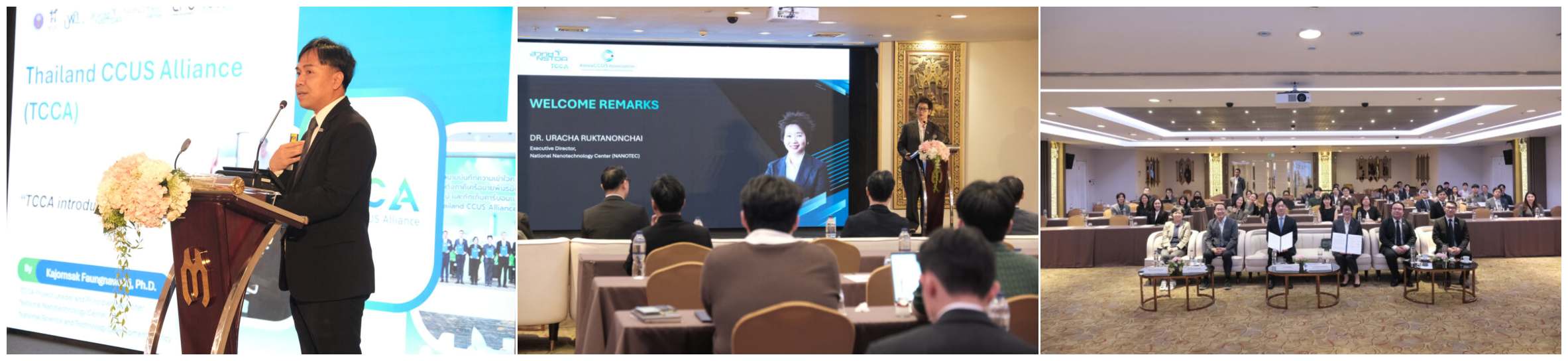
On February 9, Thailand and the Republic of Korea reinforced bilateral cooperation in
carbon capture, utilization, and storage (CCUS) through the signing of a
Memorandum of Understanding (MOU).
The agreement was signed between the
Thailand CCUS Alliance (TCCA), represented by the
National Nanotechnology Center (NANOTEC) under the National Science and Technology Development Agency (NSTDA), and the
Korea CCUS Association (KCCUS). The partnership aims to promote the exchange of technology, expertise, and experience across a broad range of areas, including
policy development, regulatory frameworks, research and development, and human resource capacity building.
Dr. HoSeob Lee, Director of the Korea CCUS Association, highlighted that Thailand and Korea share similar industrial structures and face common challenges in reducing carbon dioxide emissions from energy-intensive industries. He emphasized that
CCUS technologies are a strategic tool for industrial transformation and long-term competitiveness, and described the MOU as an important milestone that lays the foundation for more concrete cooperation in the future.
Dr. Khajornsak Fuangnawakij, Senior Researcher at NANOTEC and Project Leader of TCCA, noted that
CCUS plays a critical role in achieving Thailand’s Net Zero target under its NDC 3.0 framework. He explained that TCCA serves as a collaborative platform connecting government agencies, industrial sectors, and academic institutions to drive the systematic development of CCUS technologies. Cooperation with Korea is expected to strengthen Thailand’s human capital, expand knowledge exchange, and accelerate the translation of research outcomes into real-world industrial applications.
The partnership reflects a shared commitment by both countries to advance CCUS as a key mechanism supporting the transition toward a
sustainable, low-carbon economy and achieving long-term carbon neutrality goals.
Visit NSTDA